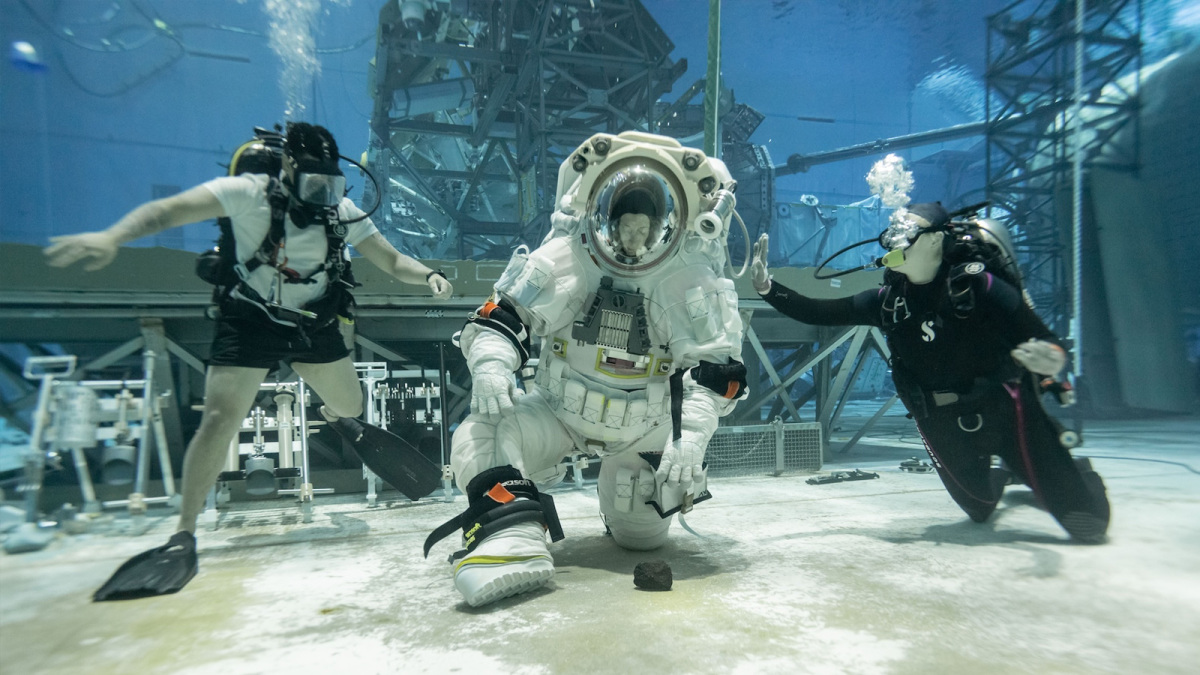
Former NASA astronaut Kathleen Rubins told a National Academies committee recently that she believes the spacesuits designed for the agency’s upcoming Artemis missions are far too heavy. She described what the Artemis crew will experience on the lunar surface as an “extreme physical event” despite the added flexibility and improvements made since the Apollo missions, Ars Technica reports.
“When we get to the lunar surface, people are going to be sleep shifting,” Rubins said. “They’re barely going to get any sleep. They’re going to be in these suits for eight or nine hours. They’re going to be doing EVAs every day.”
Part of that physical stress will come from the light lunar gravity. Although it’s only 1/6 that of Earth’s, it’s still a lot more than the microgravity experienced by astronauts performing spacewalks on the International Space Station. Rubins suggested that doing spacewalks around Earth often felt like a marathon in terms of physical exertion. Doing those same kinds of extensive EVA missions on the Moon’s surface will be even more demanding.
Credit: NASA
That’s also down to the sheer weight of modern space suits. Although the chosen Axiom spacesuit design is far more flexible than the Extravehicular Mobility Units (EMU) used on the ISS over the past few decades, it’s also heavier. That’s partly down to the added flexibility that will facilitate bending and crouching, and partly to a backpacked lifesupport system, potentially bringing the suit to several hundred pounds.
“I think the suits are better than Apollo, but I don’t think they are great right now,” Rubins said. “They still have a lot of flexibility issues. Bending down to pick up rocks is hard. The center of gravity is an issue. People are going to be falling over. I think when we say these suits aren’t bad, it’s because the suits have been so horrible that when we get something slightly less than horrible, we get all excited and we celebrate.”
Her comments were echoed by those of NASA astronaut and medical doctor Mike Barratt, who claimed that in testing, NASA had seen skin abrasions, joint pain, and even minor bone fractures from the sheer weight of the suit.
He did, however, defend the Axiom suits, saying that they were improving and would be the best option available for Artemis astronauts when they head to the moon in the next few years.
With potential delays to that mission, too, NASA has a little longer to refine the design. Rubins suggested that certain tools could help an astronaut reach or press up off the surface if they’ve fallen, which would allow for a slight reduction in mobility and, therefore, weight.