TL;DR
- Video Detection: Pangram adds AI video checks for subscribers, returning timestamped frame judgments and extending its existing image detector to uploaded clips.
- Browser Scans: Its Chrome extension flags suspected AI images while browsing, with user controls for automatic scanning and permitted sites.
- Smaller Images: The minimum input drops from 512×512 to 256×256 pixels, with reduced confidence below 512×512.
- Software Access: Pangram’s API lets developers add image and video checks to their own applications.
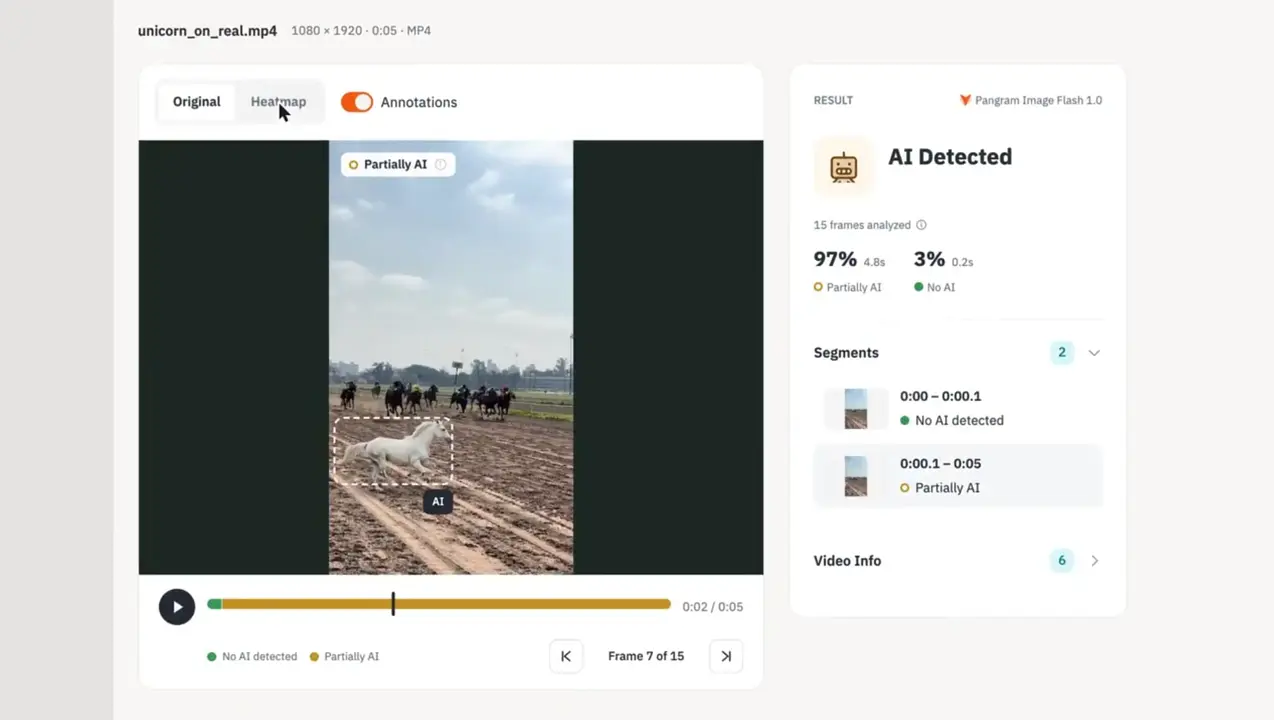
Pangram has added video analysis and browser-based image checking to its AI detection service, letting subscribers assess uploaded clips and flag suspect pictures as they browse. Released on November 4, the video tool identifies which portions of a clip appear to contain AI-generated material.
Pangram Image 1.0 is the main still-image model. Image Flash 1.0 handles both image checks and video analysis. Image results can include a heatmap, a visual guide to the regions judged likely to contain AI content, alongside an overall assessment.
From Dashboard Checks to Video Timelines
Pangram’s July research preview already offered image checks and heatmaps through its web dashboard. Its software interface, or API, was available by invitation, while video uploads and browser integration were planned. Both image models are available through the API with this release.
That earlier preview could already find synthetic material inside a real photograph. In a limited July test, TechCrunch’s Rebecca Bellan saw its heatmap illuminate an AI-generated picture photographed within a real scene. She also reported one instance in which a photographed AI image was incorrectly classified as human.
For video, the documented API samples three frames per second, or the source frame rate when lower, up to 360 samples. It returns timestamped frame judgments and groups them into labeled portions of the clip. A result can distinguish mixed content from a video assessed as entirely AI-generated, and can also return an unsure judgment.
The file limit is 500 MiB. At source rates of at least three frames per second, the sampling ceiling allows up to two minutes of footage; files exceeding processing limits fail.
The new minimum image size is 256×256 pixels, down from 512×512. Results below the old threshold carry reduced confidence. Pangram says it has also trained against compression, shrinking, blur and noise, transformations that can make redistributed online pictures harder to assess.
Pangram CEO Max Spero has demonstrated the extension on Pinterest. Users can choose whether it scans images automatically and which websites it runs on.
This is what the Chrome extension looks like on Pinterest! pic.twitter.com/FGE55u5hhU
— Max Spero (@max_spero_) November 4, 2026
Engadget observed two unsure results in that demonstration and suggested low resolution could explain them. Spero describes another difficulty: phone cameras can use AI processing to add detail to genuine photographs, so the detector has to tolerate that processing while distinguishing generative edits and wholly synthetic pictures.
We’ve been working towards AI image and video detection for months, and now it’s finally here.
There were a lot of challenges along the way. There are way more AI image/video models than frontier LLMs, and their outputs are more diverse. Most phone cameras, including iPhones,… https://t.co/V3BMopNBAL
— Max Spero (@max_spero_) November 4, 2026
How It Compares With Other Checks
Google’s SynthID Detector, introduced in 2025, looked for invisible watermarks embedded by Google’s AI systems. Pangram’s image software interface distinguishes a model judgment from a result determined by validated AI-origin metadata in the C2PA format. In the latter case, a model score can be absent because recorded provenance supplied the answer.
Other services already offer overlapping image-review functions. TruthScan provides regional heatmaps, a Chrome extension and a software interface for submitted images. Its described workflow routes high-risk submissions to a review queue with a report attached.
Sightengine’s video detection interface lets developers choose the sampling interval and inspect frame scores or combine them into a video judgment. That contrasts with Pangram’s documented three-frame-per-second sampling. Sightengine targets fully synthetic footage with this model and directs users to a separate detector for swapped or manipulated faces within otherwise real video.
What Pangram’s Tests Measure
Pangram reports 99.96% accuracy in an image evaluation built from 100 real photographs and 1,200 synthetic counterparts made with 12 generators. Matching generated scenes to real ones is intended to make the detector distinguish how an image was produced, rather than relying on the subject matter alone. Real-photo false alarms in that evaluation remain unspecified.
Pangram also reports a 98.7% score on DF26, a benchmark of videos showing people speaking. The preprint’s main detector comparison uses AUROC, which measures separation between real and synthetic clips across scoring thresholds. Pangram’s launch text leaves its own score’s metric unspecified. The paper’s tested detector roster does not include Pangram.
Access and API Charges
Pangram offers the release to subscribers and lets free accounts check a limited number of images. As of November 5, the Individual plan costs $20 per month and includes $10 in monthly API credits. API credits are also sold separately after signup.
The image-model choice changes the listed rate: Image 1.0 costs $0.25 per image, while Image Flash 1.0 costs $0.05 per image. Video costs $0.05 per source second, with partial seconds rounded up. The documented example of a 3.042-second clip is billed as four seconds, costing $0.20.